

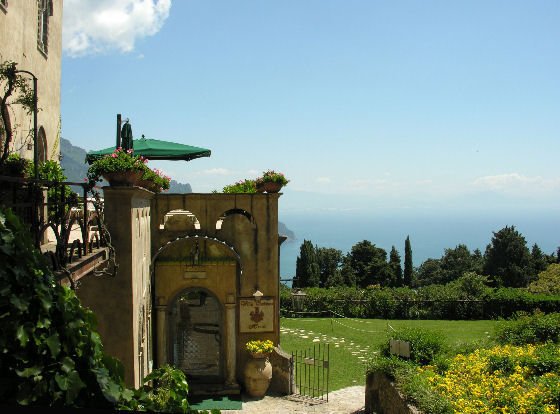
 We’re back from our walking holiday on the Amalfi coast, and my offering today is not a colourful beautiful thing. Rather, it’s a place – the Villa Cimbrone in Ravello.
Like many people, I love to bring back a souvenir of a trip to somewhere new and different. We do it not just to decorate and furnish our living spaces but to weave treasured memories and precious shared experiences into our everyday lives.
This time, though, I didn’t see anything that spoke to me enough to make me really, truly want to buy it. I try very hard these days not to buy things for the sake of it. Because I know from past experience that if I do, they just end up looking very sad and out of place once I get them back home. Or else they’re banished to languish out of sight at the back of a cupboard.
What I have brought back, though, is the memory of a visit to an exceptionally beautiful and atmospheric house and garden.
The air was so full of magic, wonder and tranquillity it was quite tangible – as real and solid as any object or thing. (You’ll have to excuse the clichés, but I’m struggling to find words to do it justice).
The Villa Cimbrone, in Ravello, is perched on the cliff edge overlooking the Mediterranean sea. The Villa itself is now a hotel, and only open to guests. However, the beautiful grounds and gardens can be visited by the general public and we were lucky to get there early in the day before the main crowds arrived.
Last year, whilst in the process of starting this website, I scribbled down a quote I heard on the radio: “Objects contain absent people”. I think it’s from a novel by Julian Barnes, but have no other details.
It resonated so strongly because it perfectly sums up for me the meaning and value of objects – “things” – which are imbued with the energy, passion, and creativity of the people who make them. And also the stories of all those who have owned, used and enjoyed them.
But places, too, can radiate similar magical qualities. You can sense the imagination and passion of those who build, renovate and restore them. The craftsmanship and expertise of the hands that construct buildings, decorate interiors and tend gardens. The footsteps of the visitors who pass through these places and spaces. And the works of art, literature and music that they inspire.
As the website of the Villa Cimbrone puts it:
“… Ravello, with its unique, still unspoilt beauty, has a long, rich and noble past. Its story is told by every corner of this enchanting place and you do not need to know the details of the history to sense its presence: you can feel it in the air.”

The original Villa Cimbrone dates from around the eleventh century when it was owned by the noble Acconciajoco family, after which it passed to the wealthy and influential Fusco family.
At some stage it became an integral part of a nearby monastery, hence the papal coat of arms of Cardinal Della Rovere at the top of the old entrance gate, but eventually the estate was abandoned and fell into disuse and disrepair. Rescue came at the end of the nineteenth century in the shape of an Englishman, Ernest William Beckett, later to become Lord Grimthorpe.
Story has it that during his Grand Tour he visited Ravello on the advice of friends to try and recover from a serious depression following the tragically early death of his much loved wife. He found such happiness and peace in this magical spot that he purchased it in 1904, and entrusted the renovation and restoration work to a local Ravello inhabitant, Nicola Mansi.
The gardens were heavily influenced by English landscape gardeners such as Harold Peto, Edwin Lutyens and Getrude Jekyll, but incorporate classical Italian influences too. According to recent studies, it is believed that the English gardener Vita Sackville-West – a friend of one of Beckett’s daughters – may have participated in the planning of the garden.

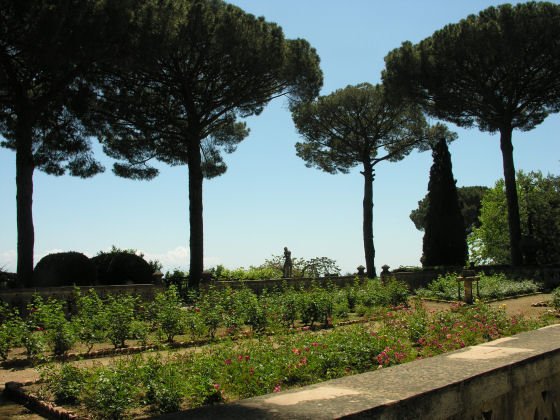
Above: the Avenue of Immensity, with its abundant wisteria. Below:the raised Rose Terrace, with views down to other parts of the gardens and out to sea.
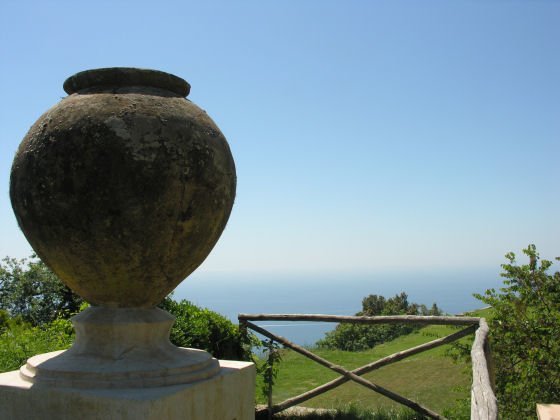 Above: one of the many giant urns. Below: views of the Terrace of Infinity with its panoramic views over the the Amalfi coast.
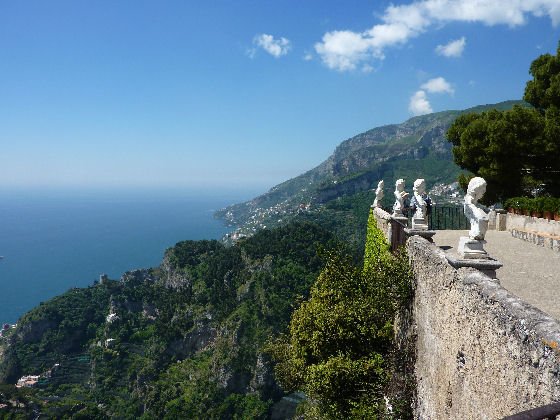
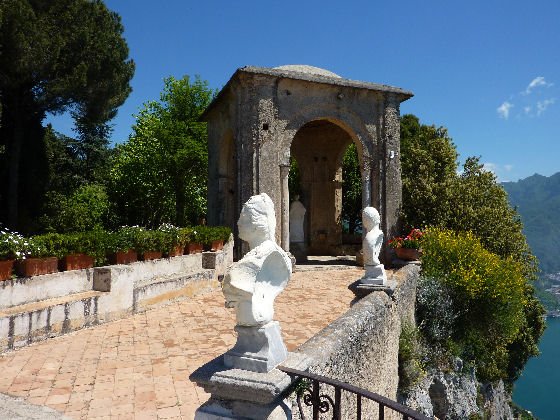
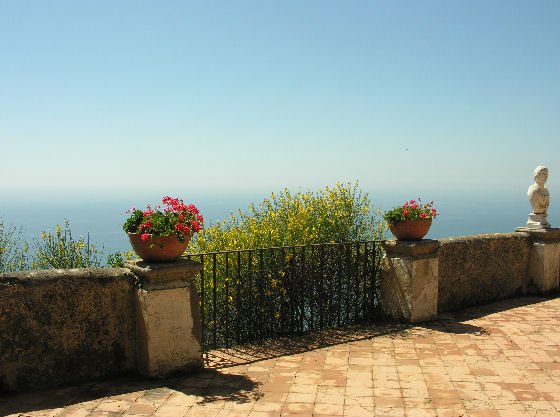
It’s hard to say exactly what makes this place so very magical. The gardens, whilst ornamental and landscaped, are also informal and park-like. Covered walkways and shady pathways through the trees lead to terraces on different levels, making the gardens feel both spacious yet somehow intimate and private too.
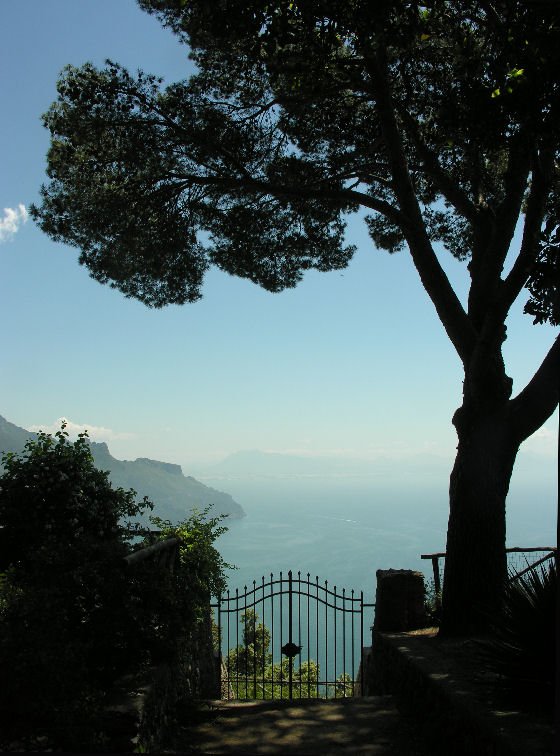
The light is particularly special. Look in almost every direction and the borders of the gardens are fringed by the bright blue of the sky and sea, whilst the strength of the sun is softened by the majestic trees and the lush vegetation.
I felt as if the extraordinary views from the terrace of blue sky and even bluer sea etched themselves onto the underside of my eyelids. For days afterwards, every time I blinked or closed my eyes I was back in Ravello at the Villa Cimbrone.
In 1976 Gore Vidal, the American writer who lived in one of the neighbouring houses in Ravello for many years, wrote of Villa Cimbrone:
This has to be one of my most precious holiday souvenirs. Not an object that needed to be wrapped up and carefully packed in the suitcase to be brought home, but a place whose magic and beauty were so palpable you felt you could reach out and actually touch them.“Twenty five years ago I was asked by an American magazine what was the most beautiful place that I had ever seen in all my travels and I said the view from the belvedere of the Villa Cimbrone on a bright winter’s day when the sky and the sea were each so vividly blue that it was not possible to tell one from the other.”
Comments are closed.