

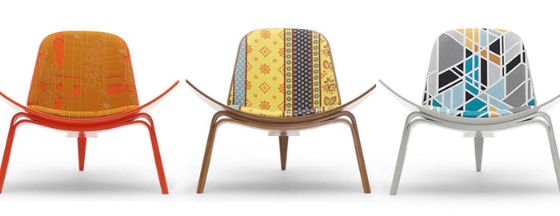
The distinctive Shell Chair, designed by Hans J Wegner for Danish furniture manufacturer Carl Hansen & Son celebrates its fiftieth birthday this year. To mark the occasion, a collaboration with U.S. textile company Maharam – The Shell Chair Project – has produced a collection of 20 special chairs each featuring a different Maharam textile and coordinating wooden frame.
 Now fêted as an icon of twentieth century design, the Shell Chair didn’t have a particularly auspicious start. Designed in 1963 to be “unique, futuristic, comfortable, and reasonably priced” the last two of the original fifteen Shell Chairs produced were eventually given away, as nobody would buy them.
Fast forward to 1997, when two of these original chairs were auctioned at Sotheby’s in London, fetching £20,000 each. You can read the full history of the Shell Chair here as told by Knud Erik Hansen, grandson of Carl Hansen and the CEO of Carl Hansen & Søn.
So this week’s Colour + Pattern = Joy! is, I think, a double dose of happiness – a beautifully designed and constructed chair (it’s also known as the Smiley Chair due to its curved front profile), plus inspired colour and pattern from innovative textile designers, past and present. Here’s my choice:
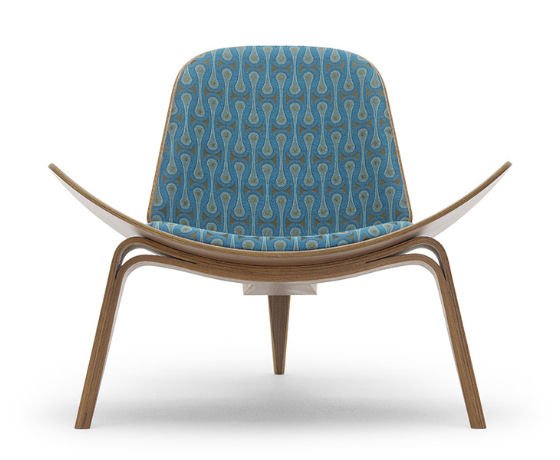
Josef Hoffmann was one of the founders of the Wiener Werkstätte -“Vienna Workshop” – in 1903, and he created this textile design, with its repeat pattern of organic geometric forms, in 1913. ‘Design 9297’ was never manufactured, however, and retains the name assigned to it in the mill archive.
The original trial sample from 1913 was created with a tapestry construction, but this re-edition is rendered in a satin weave which creates an elegant sheen, giving depth to the rich colours and highlighting its strikingly modern and graphic design.
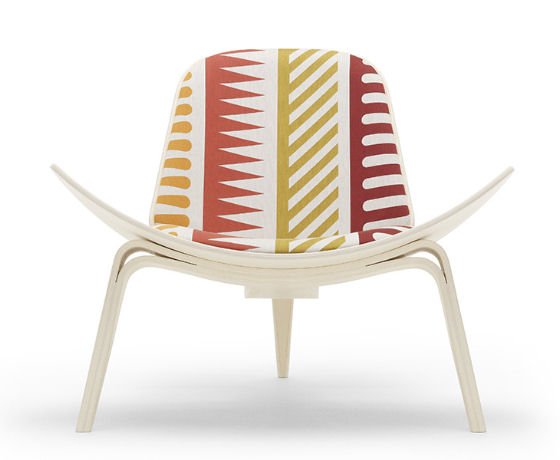
‘Palio’, designed by Alexander Girard in 1964, is the latest addition to Maharam’s Textiles of the 20th Century™ series. One of the 20th century’s most influential modernist designers and architects, Girard created more than 300 patterns throughout the 1950’s and 60’s during his tenure as Director of Design of Herman Miller’s Textile Division, drawing inspiration from his world travels and a particular interest in traditional folk art.
This fabric design is named after the famous horse race, Il Palio, that takes place twice each year around the Piazza del Campo in Siena, Italy. Bareback riders, dressed in the appropriate colours, represent ten of the seventeen contrada, or city wards, each of which have their own distinctive, colourful, and often intricately patterned, emblems which adorn flags and banners, rather like coats of arms. The eight motifs of this textile design, which include combs, fringes, flames, spikes, checkerboards, and coronets, were originally produced as individual patterns but here have been arranged into stripes.
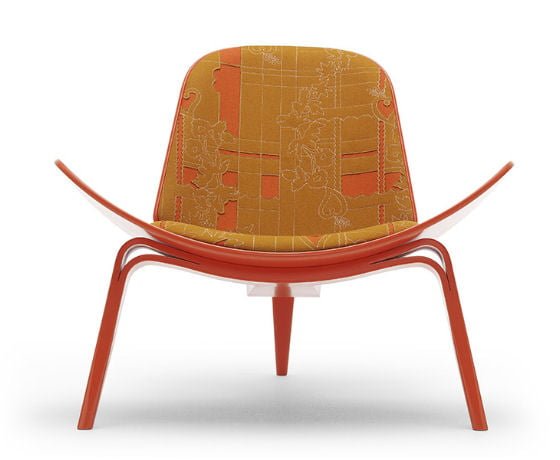
‘Layers’ by Hella Jongerius, a Berlin-based Dutch industrisal designer, has its roots in her fascination with the manipulation of traditional manufacturing methods and consists of three embroidered patterns inspired by landscapes: Layers Garden, Layers Park and Layers Vineyard.
This fabric comes in two versions, and wool felt provides the foundation for both. In the single-layer version its neutral texture serves to complement the intricate needlework that overlays it, whereas the double-layer version has hand-cut windows of pattern that reveal the felt underneath in either tonal or contrasting shades. ‘Layers’ has been accepted into the permanent collection of the Art Institute of Chicago, Cooper-Hewitt National Design Museum, the Museum of Modern Art in New York, and the Philadelphia Museum of Art.
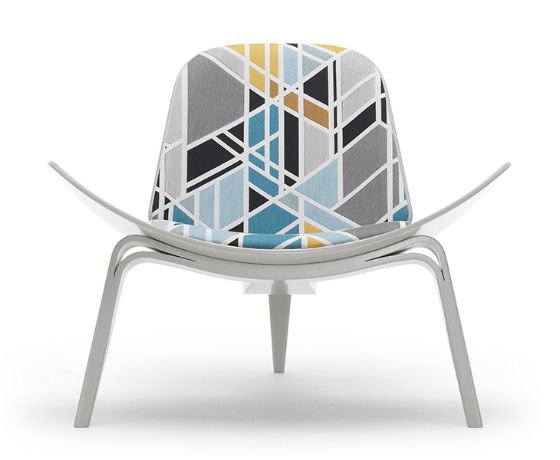
Living and working in New York, Sarah Morris is a painter and filmmaker whose large scale paintings are abstract representations of the complex patterns of urban architecture, and are typically painted in household gloss on canvases that measure more than seven feet square. ‘The Firm’, one of three textiles that she designed in collaboration with Maharam, offers a modern interpretation of traditional tapestry and is based on a painting of the same name.
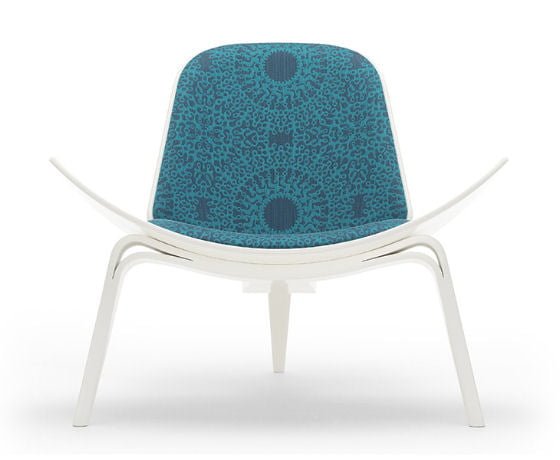
The work of Canadian graphic artist Marian Bantjes, ‘Centric’ takes its inspiration from the mandala, the geometric figure representing the universe used in sacred Buddhist and Hindu art. Known for her intricate and detailed patterning and ornamentation, Bantjes puts a fresh spin on traditional decorative pattern; this design is rendered in tone-on-tone colour combinations that lends it a contemporary feel, whilst still retaining the complexity of the original pattern.
The chairs are currently on view until mid June at the Carl Hansen & Søn showroom at 304 Hudson Street, New York, after which they’ll be for sale through authorized dealers. I’ve put the first one, by Josef Hoffman, on my fantasty interiors shopping list – which one would you choose?
Oh, and if you’re considering investing in a Shell Chair, here’s a useful post on how to spot a fake.
Images: Shell Chair Project, Apartment Therapy
Comments are closed.