

 Hue Imperial City, Central Vietman
One of the things we brought back from our trip to Vietnam at New Year was a collection of photographs of very beautiful, colourful, patterned tiled floors. I shouldn’t have been so surprised to come across them, of course. As a former French colony, Vietnam’s architecture of the period shows many European influences, including tiled floors that we would much more readily associate with the Mediterranean areas of France and Spain.
(I have quite an obsession with these gloriously patterned cement tiles – we’ve written about them before here and here. I also love that the main material they’re made from is so unglamorous but the results are utterly stunning).
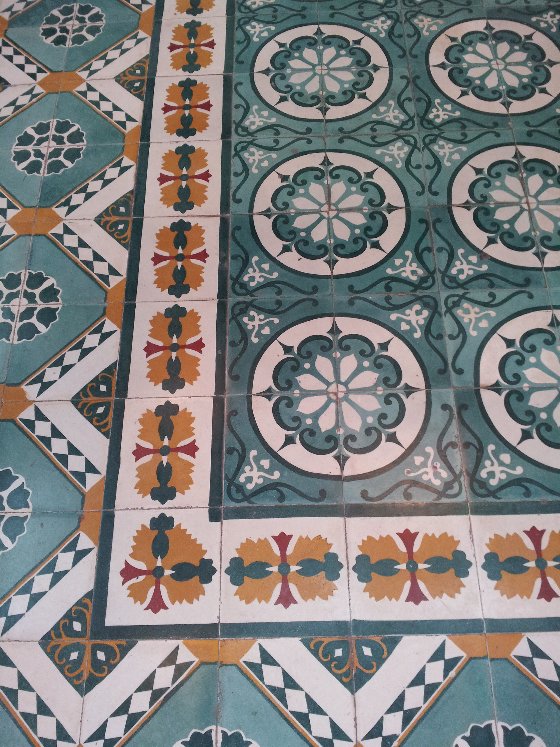 Temple in Hoi An, Central Vietnam
As I understand it, the French brought the techniques for making cement (hydraulic) tiles to Vietnam at the end of the 19th century, and production took off immediately – the only simple machinery needed was a hydraulic press, whilst the main processes were all done by hand. Initially the tiles were considered a high-end building and decorative material and used extensively in churches, villas and other prestigious buildings.
 Notre Dame Cathedral, Ho Chi Minh City
 Chinese Assembly Hall, Hoi An, Central Vietnam
 Hue Imperial City, Central Vietman
Temple in Hoi An, Central Vietnam
At the beginning of the 20th century patterned cement tiled floors were very much a feature of Vietnamese architecture and a thriving, albeit small-scale and family-run, manufacturing industry had developed in Saigon.
But in post-colonial times production started to decline. Fashions and materials changed, ceramic tiles arrived and cement tiles started to beregarded as an inferior product used mainly by poorer people and in public buildings such as schools and hospitals.
 The Old Post Office, Ho Chi Minh City
 Cafe Floor, Ho Chi Minh City
Nowadays, though, just like here in the UK, there is renewed interest in Vietnam in the patterns and processes that produced so many gorgeous floors in years gone by and production is again starting to flourish. If I had a house project that needed wall or floor tiles, I’d definitely be looking to these masterpieces of the past for inspiration.
Images: © colourful beautiful things



Comments are closed.